Nanofictionary Home

Product Description

How do you play?

FAQ

Links & Reviews

Testimonials

Buy it!

Official Rules to Nanofictionary
(as of Feb 7th, 2002)

OVERVIEW

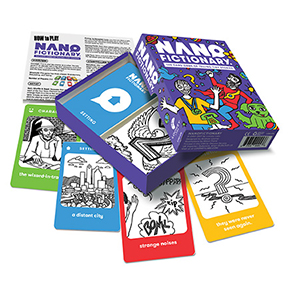
Nanofictionary is a game about making up tiny stories. Even an extremely short narrative can tell a complete story, provided it contains each of four specific "plot devices," namely: a Setting, a Problem, at least one Character, and a Resolution. In this card game then, there are four basic types of cards, corresponding to these four plot devices. Each player works at developing the basic structure of a story by building up a collection of these cards. A fifth type of card, called an Action, will allow players to add Complications to their stories, Brainstorm new ideas, Plagiarize from other players, and Uncrumple old ideas out of the discard pile.

The game progresses through three separate phases. First comes the Writing Phase, in which everyone develops the outline of a story by collecting the 4 types of plot devices. Then, in the Storytelling Phase, the players take turns telling short stories based on their cards, embellishing as needed to unite and explain the elements on the cards. This is followed by the Awards Phase, in which prize cards are given to the authors of the most popular stories. However, extra points are also awarded for finishing early, and for having more cards in your story, so the winner is determined at the very end, when everyone adds up their points. Whoever gets the highest overall score wins!

Number of Players: 3-6, though additional participants may join the game at the start of the Storytelling Phase, provided all players agree. These additional players are called Jurors, and they too will have points to allocate to the stories they think are best.

Ages: 10 to Adult

Playing Time: 30-45 minutes

SETUP

Deal out 5 cards to each player, then place the draw pile where all players can reach it. Set aside the Prize cards for now, but place the Completion Bonuses (the cards numbered 1 through 6) in the center of the table near the draw pile, with the highest number on top. Use only as many numbers as there are players in the game, setting aside any extras (i.e. if there are only four players, use just the numbers 1 through 4.)

WRITING PHASE

Play Options: During the Writing Phase, each player will draw a card, add it to their hand, and then perform ONE of the following three options:
1.) Add a Plot Device (Character, Setting, Problem, or Resolution) to your story
2.) Use an Action card by discarding it and following its instructions
3.) Discard as many cards as you wish, and draw back to 5

Adding to your Story: To play a Plot Device card, just place it on the table in front of you (like you would with a Keeper in Fluxx), thus forming the outline of your story. Place the card face-up unless it's a Resolution; in order to keep the endings secret until they are revealed during the Storytelling phase, all Resolution cards are played face-down.

Story Limitations: You may have as many Characters in your story as you want; however, your story can only have one Problem, one Setting, and one Resolution. If you play a new card of one of these varieties, you must discard the existing Problem, Setting, or Resolution. Please note, however, that the Action card called Complication will allow you to add a second Problem, Setting, or Resolution to your story.

Actions: Action cards let you do something more complex than simply adding to your story. There are 4 different types: Complication, Brainstorm, Plagiarize, and Uncrumple. Just put the card you are playing on the discard pile and do what it says.

Specifically, the 4 Actions work as follows:

Discarding: Instead of playing a card, you may choose to simply throw one away. In this case, you may discard as many additional cards as you wish, and then draw back to a hand of five cards.

Open Discard Pile: Because of the Uncrumple action, it is permissible for anyone to search through the discard pile at any time. You may even wish to sort the discards by type, and arrange them in stacked piles, so that everything in the discard pile can be seen at a glance.

Simultaneous Play: During the Writing Phase, all players will be working on their stories at the same time. This means everyone will take one turn at the same time, and when all have completed that turn, they'll move on together to the next. A turn begins with all players adding a card to their hands, and each may then perform their action for that turn whenever they are ready. When you have completed your action for the current turn (you'll know you're done when you have 5 cards in your hand again) you should indicate you are ready for the next turn by setting your hand down, in front of your story.

The Goal: The object of the game is to collect together a set of Plot Device cards which tell an interesting tale. Think of your cards as the building blocks for a story you are writing. When the Storytelling phase comes around, you will be telling a brief story using your collection of cards as the core elements of your tale. So, if you're thinking about a murder mystery, you might be looking for a Problem card that fits such a story, such as A Dead Body. Or if you have a good set-up with your Setting and Problem, you might be looking for a particular kind of Resolution or some interesting Characters to flesh it out with. While you are free to embellish a bit when telling your story, the more you involve your cards, the better.

Completing Your Story: There's a fourth play option, which you can perform at any time: if you have at least one each of the four Plot Devices, and you are satisfied with the cards you have in your collection, you may declare your story to be complete. Do this by taking the highest remaining Completion Bonus card from the numbered pile. This will be the number of extra points you get for completing your story early. At this point, you are out of the game until the next phase begins. Discard your entire hand, and gather up the cards in your story, placing them in a single pile, underneath your Bonus card. Your story can no longer be affected by other players, and your turn is skipped from now on. (If you're in a big game and you went out early, you might even have time to sneak off to the kitchen for a snack.)

The Last Person's Last Turn: Once all but one person have declared that their story is complete, that last person gets one more turn to try to complete his or her story. After that turn, that player receives the number 1 card automatically, and the next phase of the game begins. If the last player does not have at least one of each of the plot devices, that player will be ineligible to receive any prizes during the Awards phase.

First Come, First Served: Even with everyone playing at the same time, timing conflicts will not occur frequently. However, there will be occasions when 2 players reach for a card at the same time. It goes to whoever gets there first.

Re-Shuffling: When the deck is exhausted, just shuffle the discard pile and keep going.

STORYTELLING PHASE

Try Recruiting Jurors: The start of the Storytelling phase is the time to bring in any extra people that you happen to have hanging around. They can be impartial jurors who will listen to the stories, then help decide which is best by putting in their two cents. (See the section on Jury Awards below.)

Now the Real Fun Begins: It's time to tell your story! Players now take turns telling a brief tale based on the cards they have in play. Whoever took the highest Completion Bonus goes first. You may discard any extra cards in your story that you don't want to use, but you must have at least one of each plot device. You must incorporate into your story all plot devices that you keep. After a player finishes a story (as indicated by saying "The End" or something similar), the player with the next highest number will proceed, until all players have told their stories. Then it will be time for the Awards phase.

It's All in the Embellishment: As you tell your story, feel free to elaborate somewhat on the outline presented by your cards, but remember too that these cards must form the core of your tale. For example, you shouldn't create any major new characters who aren't on your cards. Also, remember that this is Nanofictionary not Megafictionary, so don't let your story run too long!

Pictures are Serving Suggestions Only: Do not feel restricted by the illustrations, they represent just one idea for the Plot Devices they illustrate. As you tell your story, use words to paint your own pictures.

Gender Bender: Sometimes a card will suggest that a Character is male or female. However, when you are telling your story, you are welcome to alter these gender determinations in whatever ways you see fit. Similarly, you may also "bend" numbers and quantities as you wish, changing a group of something into just one, or pluralizing something singular.

Schizoid Characters: In some cases, several character cards might all end up as one character in your story. For example, the Troubled Loner could end up being elected President, or he might at least become the Assistant Manager (or even both). This is perfectly acceptable. Similarly, a Character can turn into a Problem; for example, the Bleary-Eyed Waitress might end up becoming a Dead Body.

55 Words? This game was inspired by the writing form that limits a short story to a mere 55 words, which Andy nicknamed "Nanofiction." However, there is no need to limit yourself in this way when telling your story. It should be brief of course, but you don't need to count words. Think more of the limit as being however much you could write down on the back of a large envelope. (However, if you find yourself inspired to write down a 55-word version of a story you think up during this game, feel free to send it to us. Perhaps we'll post it on our website!)

AWARDS PHASE

Getting Ready: Deal to each player a Grand Prize card, a Runner-Up card, and X random cards from the deck, where X = (# of players - 3). These extra cards will be considered Honorable Mentions, so everyone should now have one Award card for each other player in the game. Also, find two pennies for each Juror.

Voting: Before passing out the awards, give everyone a chance to refresh their memories about all the stories, by examining the cards on the table. If everyone agrees, you can even allow a brief recap of each story. Then, all players will place one of their award cards, face down, onto each of the number cards in front of the other players' stories. Naturally, you should give the Grand Prize to the player whose story you liked best, with the Runner-Up going to the second best story, and the others receiving your Honorable Mentions. However, you cannot give any awards to yourself, nor can you give two awards to the same player. After all Award cards have been given out, players will reveal what awards they received, and begin adding up their scores. Honorable Mentions are not worth any points, and should be discarded again at this time.

Jury Awards: At the start of the Storytelling phase, a call should go out to anyone in the vicinity who may have missed out on the chance to play but who might want to serve on the Jury. All players must agree to each juror; if someone can't be impartial, they should not be a juror. The members of the Jury will listen to all the stories and then cast their own votes, in the form of two pennies, which are worth 2 points. After all players have given out their Award cards, the Jurors shall count to 3, then point to the player who told the story they liked best. (The jurors must declare at the same time, so that they aren't influenced by each other's votes; if you only have one juror, you can dispense with this.) After indicating their favorites, the Jurors will award their 2¢ to whoever they pointed at. Each Juror must select one a single story to be the recipient of their award; a juror's 2 points cannot be divided between two players.

You Must Be Eligible to Win: Remember that anyone who doesn't have at least one of each kind of plot device is ineligible for Grand prize awards, Runner-up awards, or Juror awards.

Criteria for Judging: How you distribute your awards is up to you. However, here are a few things to consider as you make your decision. Did the player really make use of the ideas on the cards, or were other characters and problems pulled in out of thin air? Did the story drag on too long, or did every word hold your attention? Did it make you laugh? Cry? Feel some other way? Did it seem just like some other story you've heard before, or was it fresh and original? Were you surprised when the Resolution card was revealed, or was the ending predictable? Most importantly, did the story make sense? At least mostly?

Scoring: After the awards have all been given out, it's time to count the scores. Whoever has the highest wins the game, and is a true Storytelling Master. To compute your final score, add up the following:

Breaking Ties: In the event of a tie, the winner will be the player who finished first (i.e. whoever holds the highest completion number.)

Scoring Phase Example: Dave is in a game with 6 players. He has three characters in play: the Troubled Loner that no one really pays attention to, the Dude who always says "Dude!", and the Time Traveler visiting from 1888. He has one Problem (a Dead Body), one Setting (a Polynesian Tiki Lounge), and one Resolution (They Were Never Seen Again). He completed his story fairly early, being the third person to go out, so has the number 4. He told a great story, and received two Grand Prizes, two Runner-ups, and one Juror vote. So his final total is 6 (number of cards in his story) plus 4 (completion bonus) plus 6 (two Grand Prizes) plus 2 (two Runner-ups) plus 2 (one Juror vote) which comes to a total of 20. Wow! This is higher than anyone else's score, so Dave wins!

A DIFFERENT WAY TO PLAY: ANTHOLOGY

Here's a different game for Nanofictionary cards, which involves telling lots of stories in a short amount of time. Separate the deck into the four different plot devices, removing the Action cards. Have one player start as the "judge" and deal the next player one each of the four different plot devices. That player tells a story using those four cards. Then the next player tells a different story based on the same set of cards, until everyone but the judge has told such a story. The Judge then gives out the two Award cards as normal, after which the Judge position passes to the next person, who deals out four new cards. Keep going like this until everyone has had a chance to be Judge. Highest point total from Awards at the end wins.

CREDITS

Designer: Andrew Looney
Artist: Alison "Looney" Frane
Producer: Kristin Looney
Rules Written by: Andrew Looney and Dave Chalker
Contributing Playtesters: Alison Frane, Kristin Looney, Dave Chalker, Liam Bryan, Mike Sugarbaker, Travis Larchuk, and the Wunderland Toast Society
Beta-Testers: Peggy & Tom Aylesworth, Keith Baker, Jana Bradley, Kerry Breitenbach, Lauren Brown, Marlene Bruce, Eric V. Clark, Gina Mai Denn, Charles ("#12") Dickson, Nathan Dilday, Greykell Dutton, Bob Galloway, Alvaro Gonzalez, Avram Grumer, Ammy Hill and her friends, Dan Isaac, Suzyn Jackson, Kevin Jackson-Mead, Leah & Frank Kanach, Shaun Klein, Jen & Michael Kolodner, Joshua Kronegold, Michelle Lepovic, Petra Mayer, Ryan McGuire, Jason McIntosh, Janet Morton, Denis Moskowitz, Christia Mulvey, Dale Newfield, Brian Newman, Jason Ogden, Glenn Overby II, Jeri Overby, John Padavan, Lisa Padol, Chris Paulin, Kerin Schiesser, Teeje, Tim Seiger, Jesse Welton, David Wendt and Doc Blue's Brigade, Shel West, Patrick Wheeler , Eric & Beth Zuckerman, Sam Zitin, Zach and the other MSOE Anime and Gaming Enthusiasts, the Badger Lodge, The Larchuks & the Entenmanns, The Round Circle, and other friends too numerous to mention
55 Fiction concept created by Steve Moss


News

Search

Gift Shop

Games

About Us


http://www.wunderland.com | contact us
Last Modified: Aug 21 2008 at 17:08